Framework for Infant–Toddler Learning and Development
The Framework for Infant–Toddler Learning and Development presents guidance on planning relationships and interactions, routines, and environment and materials to support the learning and development of infants and toddlers. Aligned to the California Infant–Toddler Learning and Development Foundations (ITLDF), it describes how young children learn and develop across the domains of Social and Emotional development, Approaches to Learning, Language Development, Cognitive Development, and Perceptual and Motor Development.
Select the sections below to learn more about each chapter of the framework. To access the full chapters, please download the Framework for Infant–Toddler Learning and Development here.
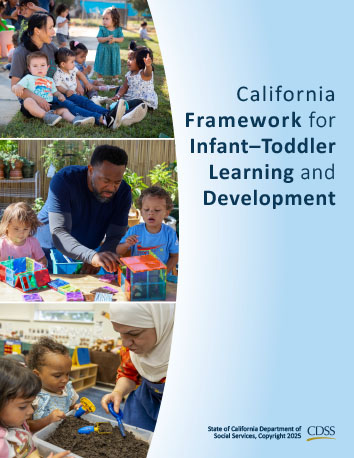
Organization of the Framework for Infant–Toddler Learning and Development
Introduction
This chapter provides overarching framing and guidance, addressing the broader context for early development and learning, program features that support infant–toddler learning and development, important considerations for how infants and toddlers learn, and guiding principles that address how to plan possibilities for early learning and development.
Key sections in Chapter 1:
- Organization of the Framework for Infant–Toddler Learning and Development
- The Context for Early Learning and Development
- Program Features That Support Infant–Toddler Learning and Development
- The Infant–Toddler Learning Process: The Starting Point
- Principles Underlying the Support of Early Learning and Development
Planning to Support Infant–Toddler Learning and Development
This chapter discusses how infant–toddler care educators support development by engaging in the planning cycle of observing and documenting, studying and interpreting, planning, and implementing a plan. The chapter introduces and discusses how care educators plan individualized support for infant and toddler development in three contexts: relationships and interactions, routines, and environment and materials. Discussion and examples illustrate the planning cycle and emphasize ongoing reflection and partnering with families to understand each child’s strengths, interests, and needs. By incorporating reflection at every step of the cycle, care educators continually adjust to support young children’s learning and development.
Download chapter
Planning to Support Infant–Toddler Learning and Development
Relationships and Interactions
Relationships and interactions are at the heart of children’s growth and learning. When infants and toddlers are in the care of individuals outside their family, secure relationships as well as consistent and responsive interactions help young children learn and build self-confidence.
Every child develops in their own way, shaped by their lived experiences, culture, and home languages. Interactions happen anytime children connect with others—during routines, play, or daily activities. When care educators plan and engage in responsive interactions as part of caring relationships, these everyday moments support children’s understanding of themselves and the world around them.
Information on supporting relationships and interactions is organized into six areas of practice.
Table 1. Areas of Practice for Relationships and Interactions
| Area of Practice | Practices |
|---|---|
| Partnering with Families to Support Interactions | Practices:
|
| Individualizing Interactions to Meet Each Child’s Needs | Practices:
|
| Being Sensitive and Responsive to Children’s Cues and Communication | Practices:
|
| Communicating During Interactions to Prompt Thinking and New Learning | Practices:
|
| Centering Play and Social Interactions | Practices:
|
| Scaffolding and Modeling New Skills and Behaviors | Practices:
|

Routines
Routines help infants and toddlers feel safe and ready to grow and learn. They are predictable parts of the day, like feeding, sleeping, diapering, and transitions (such as arrivals and departures). This regularity builds trust and supports strong relationships.
Routines are more than daily tasks—they are learning opportunities. Children build communication, physical skills, and healthy habits during these times. Consistent routines help children know what to expect, making transitions smoother.
When care educators plan routines with care, they can respond to each child’s needs and interests. This creates meaningful, individualized learning experiences and supports children’s growth and development throughout the day.
Information on supporting routines is organized into six areas of practice.
Table 2. Areas of Practice for Routines
| Areas of Practice | Practices |
|---|---|
| Partnering With Families | Practices:
|
| Establishing Predictable and Consistent Routines | Practices:
|
| Being Responsive and Modifying Routines Based on Observations and Children’s Shifting Needs | Practices:
|
| Individualizing Routines to Meet Child’s Needs | Practices:
|
| Encouraging Infants and Toddlers to Play an Active Role in Routines | Practices:
|
| Communicating With Infants and Toddlers During Routines | Practices:
|
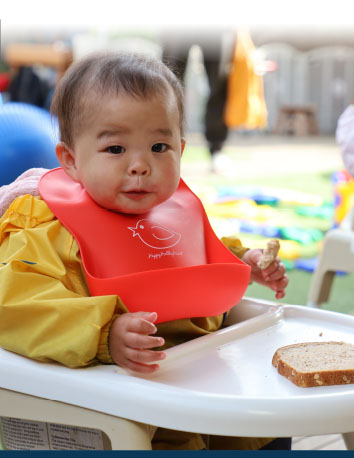
Environment and Materials
A rich learning environment supports infants and toddlers to play, explore, grow, and take part in routines. The environment is a safe, nurturing space set up to support learning and development. Materials are the objects and equipment thoughtfully placed in the environment for children to use and explore.
Well-planned environments include a variety of spaces and materials that can change to meet different needs. For example, there may be open areas for movement, cozy areas for books, outdoor areas for nature play, and tables for meals. These everyday spaces and materials provide young children with many ways to investigate, interact with others, manipulate materials, and build new skills through play and curiosity.
Information on supporting set-up of the environment and materials is organized into five areas of practice.
Table 3. Areas of Practices for the Environment and Materials
| Areas of Practice | Practices |
|---|---|
| Partnering With Families in Arranging the Environment and Materials | Practices:
|
| Arranging the Environment With Predictable Areas | Practices:
|
| Individualizing the Environment and Materials to Meet Each Child’s Strengths and Needs | Practices:
|
| Providing a Variety of Materials That Children Can Explore | Practices:
|
| Planning and Updating the Environment and Materials Based on Children’s Interests | Practices:
|