
Domain
Social and Emotional Development
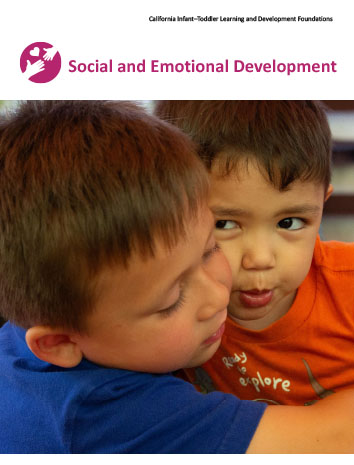
Social and emotional development during the first three years includes infants’ and toddlers’ sense of self and agency to make things happen in their environment, their expression and regulation of emotions and behaviors, and their social interaction skills. Right from the beginning of life, infants are forming close, essential relationships with caregivers. These relationships are fundamental for attachments as well as for the interactions that shape children’s emerging social and emotional development.
Why is Social and Emotional Development Important?
From their first cry and the moment they are soothed by a caregiver’s response, infants are social and emotional beings. The cry is just one of several ways young infants express their feelings and needs to others. In the early years, social development is highly integrated with emotional development as infants and toddlers navigate their world in relationships with caregivers, peers, and other people. Infants’ and toddlers’ social and emotional development is critical to their mental health and overall well-being and development.
What Skills and Knowledge are Described in the Social and Emotional Development Domain?
The skills and knowledge described in the Social and Emotional Development domain are organized into the following three strands:
- Self
- Social Interactions
- Relationships
Foundations for birth–36 months
Open the strands below to explore how the foundations apply to age periods birth–4 months, 4–11 months, 11–23 months, and 23–36 months.
Strand 1.0Self
The Self strand includes infants’ and toddlers’ sense of identity as an individual and in relation to others, as well as their sense of agency and emerging abilities. The Self strand also addresses infants’ and toddlers’ expression and learning to coregulate and regulate emotions and behaviors.
Age: Birth–4 Months
First Four Months
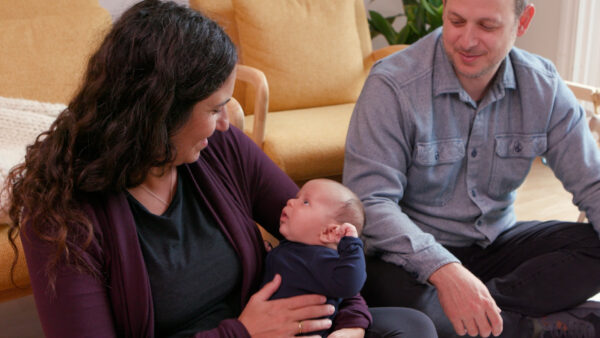
Early on, infants are actors in their environment, expressing primary emotions like joy and fear and expressing their interests and needs. Infants’ expression of emotion, their interactions, and their experiences are also influenced by their cultural context, as reflected in their family and community practices and values. In the early months infants engage in the following:
- express their essential needs (for example, hunger, alleviating discomfort) through various nonverbal cues, vocalizations, and signs of distress (for example, crying or looking away from the caregiver’s face)
- show discrete emotional expressions (for example, smiling, laughing)
- show varying temperament tendencies around activity level, reaction to the unexpected, attention and regulation, anger/irritability/frustration, and exuberance/enthusiasm/cheerfulness
- demonstrate awareness of their hands and feet as they learn how to use their bodies (for example, putting a hand in their mouth, grasping a caregiver’s finger)
Age: 4–36 Months
Foundations for ages 4–11 months, 11–23 months, and 23–36 months.
Foundation 1.1Sense of Identity and Belonging
Indicators
4–11 Months
Children show developing understanding that others are both distinct from and connected to themselves, attending to physical characteristics (for example, facial features) that are associated with race, ethnicity, and gender.
11–23 Months
Children demonstrate awareness of their own features and express themselves as distinct persons with characteristics, thoughts, and feelings. Children also demonstrate awareness of others’ behaviors, responses, and characteristics within their developing relationships with caregivers.
23–36 Months
Children identify their feelings, needs, and interests and sometimes identify themselves and others as members of one or more groups by referring to social categories (for example, race, ethnicity, gender) or cultural practices.

For example, a child may...
- Orient toward a person who calls their name.
- Wave their arms and kick their legs when they see or hear a familiar person enter the room.
- Cry when their preferred caregiver leaves the room.
- Look at pictures of caregivers’ faces on the wall with interest.
- Notice when they hear a relative speaking their home language.
For example, a child may...
- Use name or other family label (for example, nickname, birth order, “little sister”) when referring to self.
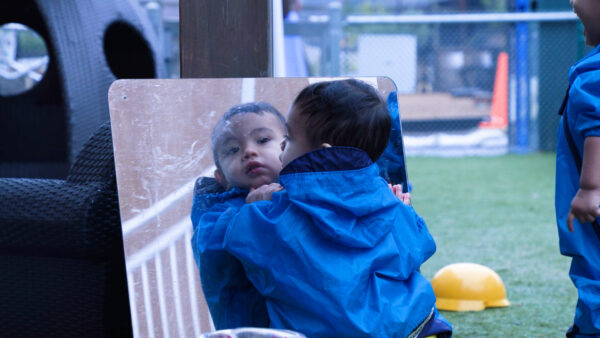
- Recognize their own image in the mirror and understand that it is themself.
- Point to or indicate parts of the body when asked. For example, they communicate in Hupa, “whe: da′ay” and point to their head.
- Move excitedly when approached by a person who usually engages in active play.
- Imitate and/or learn a new action or word better from a person who speaks familiar languages compared to unfamiliar languages.
- Point to a picture in a book that resembles a family member through a shared attribute such as gender or skin color (for example, point to picture of a woman with a scarf and communicate “Mama” in the home language).

For example, a child may...
- Communicate their own name.
- Use pronouns such as I, me, you, we, they, he, and she.
- Make a few simple comparisons between self and others. For example, they communicate, “Lucas is a boy like me.”
- Make comparisons between family members and others. For example, see a person dressed in a sari and communicate, “Her dress like Nani.”
- Demonstrate preference for specific items (for example, puzzles, cars, dress-up clothes) or activities.
- Demonstrate play preferences with children of familiar age, gender, or race and/or children who speak the same language.
The Influence of Context on Children’s Sense of Group Membership
Children learn about group membership based on the people they see and do not see on a regular basis across different types of contexts, such as care locations, offices, media, and neighborhoods. Children’s sense of group membership is shaped by the type of language the people around them use to describe a person or group of people, such as language around skin color. Children benefit from becoming familiar with people who are different from them, as these experiences shape children’s processing and understanding of similarities and differences in others (Ellis et al., 2017; Hwang et al., 2021).
Foundation 1.2Recognition of Agency
Indicators
4–11 Months
Children show an understanding that they are able to make things happen.
11–23 Months
Children experiment with different ways of making things happen, persist in trying to do things even when faced with difficulty, and show a sense of satisfaction with what they can do.
23–36 Months
Children show an understanding of their own abilities to make things happen and sometimes refer to those abilities when describing themselves.

For example, a child may...
- Raise their arms to be picked up and placed on a changing table by a caregiver.
- Shake a musical toy (for example, rattle) to try to make the music come on again.
- Initiate a favorite game. For example, hold out a foot to a caregiver to start a game of “This Little Piggy.”
- Gesture at a book and smile with satisfaction after a person gets it down from the shelf.
- Intentionally and repeatedly drop objects, notice what happens, and express happiness each time.

For example, a child may...
- Gesture to caregiver that they have a soiled diaper and after caregiver helps to change their diaper, they communicate in their home language, “All clean now!” and cheer together.
- Bounce with joy after making a handprint with paint.
- Roll a small car back and forth on the ground, then push it really hard and let go to see what happens.
- Squeeze a toy in different ways to hear the sounds it makes.
- Smile after walking up a steep incline without falling or after carrying a bucket filled with sand from one place to another without spilling.

For example, a child may...
- Insist on using the toilet by themself even after a caregiver attempts to provide assistance.
- Comment about their abilities by communicating, “I doing this.”
- Communicate in Spanish, “Me puse los zapatos” (I put my shoes on) after helping to slip their sneakers on.
- Finish a painting and hold it up to show another person.
- Complete a challenging puzzle for the first time and clap or express in Cantonese, “我好叻砌圖。” (I’m good at puzzles).
Foundation 1.3Expression of Emotion
Indicators
4–11 Months
Children express a variety of primary emotions such as contentment, joy, sadness, interest, surprise, disgust, anger, and fear in response to different experiences.
11–23 Months
Children express emotions in clear and intentional ways and express some secondary emotions, such as pride, through a variety of behaviors.
23–36 Months
Children express secondary, self-conscious emotions such as pride, embarrassment, shame, and guilt. Children demonstrate awareness of their feelings by communicating words or gestures to describe feelings to others or acting them out in pretend play.

For example, a child may...
- Cry in anger when another child takes away their comfort object.
- Exhibit wariness, cry, or turn away when a stranger approaches.
- Wave their arms and legs when a caregiver sings to them.
- Stop crying and snuggle after being picked up by a caregiver.
- Open their mouth in surprise when a person removes the blanket covering their face to start a game of peekaboo.
- Laugh when a person lifts them above their head.
- Try a new food and react with a facial expression showing disgust.

For example, a child may...
- Express anger at having a toy taken away by taking it back out of another child’s hands or hitting them.
- Show affection for a person by hugging.
- Express jealousy by trying to crowd onto a person’s lap when another child is already sitting there.
- Smile directly at other children when interacting with them.
- Clap or smile when correctly identifying an object in their home language.
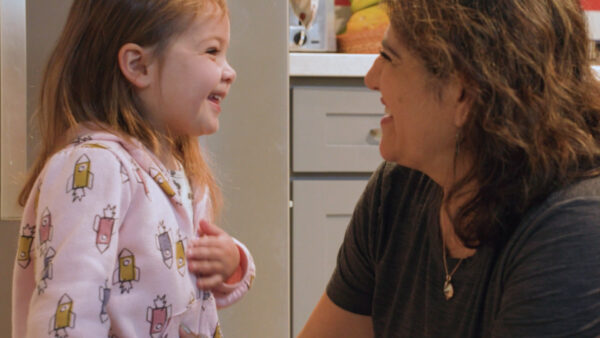
For example, a child may...
- Communicate “I am angry” using a communication board and clench their fists when another child takes a toy from them.
- Hide their face with their hands when feeling embarrassed.
- Express a feeling by communicating in Spanish, “No me gusta” (I don’t like that).
- Communicate in Tagalog, “Miss ko si Lola” (I miss Grandma) after talking on the phone with her.
- Act out different emotions during pretend play by “crying” when pretending to be sad and “cooing” when pretending to be happy.
- Express guilt after taking a toy out of another child’s cubby without permission by trying to put it back without anyone seeing.
Culture and Children’s Expression of Emotion
Children’s expression of emotion is shaped by their cultural context. Caregivers may foster expression of emotions in different ways based on their cultural values and practices. For example, a child may be raised to express their emotions either more externally or more internally, to show certain emotions but not other emotions, or to wait for cues or permission from authority to express their emotions. Family and cultural expectations may also influence whether a child may be encouraged to express certain emotions but not others based on gender expectations. Care educators can build relationships with families to learn about families’ cultural values and preferences for their child’s care, as well as the stories, routines, and practices that they share with their child. Given the influence of culture, care educators should also pay attention to how their own beliefs and values shape children’s expression of emotion and behavior.
Foundation 1.4Regulating Emotions and Behaviors
Indicators
4–11 Months
Children use simple self-soothing behaviors to comfort themselves. Children often need help managing their emotions and behavior and show emerging ability to communicate the need for help with discomfort or distress.
11–23 Months
Children demonstrate a variety of ways either to comfort themselves or to avoid or ignore situations that cause discomfort. Children require support with managing strong emotions and are responsive to choices and expectations set by caregivers. Children also communicate feelings and wants through words and gestures.
23–36 Months
Children anticipate the need for comfort and try to prepare themselves for transitions. Children sometimes manage behaviors and emotions with little or no caregiver support. Children show many self-comforting behaviors, depending on the situation, and communicate specific feelings.

For example, a child may...
- Stop crying when a caregiver offers them a comfort item.
- Fuss when placed on the blanket and start smiling and making sounds of contentment when a caregiver provides a calm, attentive presence.
- Turn or crawl away from an object that makes a scary noise.
- Suck their thumb to make themself feel better.
- Turn their head away or push the bottle away when they finish eating.
- Stop crying when rocked back and forth by a caregiver.

For example, a child may...
- Use comfort objects, such as a baby blanket or stuffed toy, to help calm down.
- Play with a toy as a way to distract themself from discomfort.
- Seek to be close to a caregiver when upset.
- React intensely such as by throwing an object, hitting, or shutting down (unable to express themself or becoming nonresponsive) when activated or frustrated.
- Stop coloring on the wall and choose to color on an easel when a caregiver explains that they can color on paper or the easel but not on walls.
- Approach the care educator for a hug and express in Mandarin, “奶奶上班” (Grandma work), then point to the door to communicate they miss their grandma.
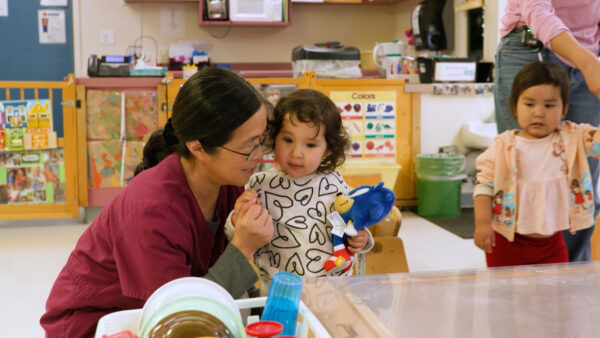
For example, a child may...
- Gesture to ask a caregiver for a comfort item before getting into the car seat for a long ride.
- Show the care educator that they like a special song during naptime by humming the melody of a song while lying on the cot.
- Make fewer attempts to bite other children when provided with a chewing necklace.
- Have a developmental delay, and when prepared ahead of time or when they have some choice over what happens, handle transitions better.
- Play quietly in a cozy corner of the room right after drop-off until ready to play with the other children.
- Share or cope with emotions by acting out emotional experiences or traumatic events while playing to try to gain mastery over or cope with their feelings.
Note: This foundation is closely related to Foundation 2.2 Inhibitory Control in the ATL domain. Both foundations play an important role in how children learn to manage their behaviors and emotions.
Variation in Children’s Regulation of Behavior
Children’s behavior and regulation of behavior are influenced by individual factors, such as temperament tendencies, and environmental factors, such as cultural beliefs and practices and relationships with caregivers. Caregivers may demonstrate varying expectations and goals around children’s behavior. At home, a child may be encouraged to move around freely. Another child may be encouraged to be quiet as a sign of respect for authority figures or maintain harmony within the group.
Children’s unique temperament tendencies influence their behavior in different situations, including the ways they voluntarily regulate their emotions and behaviors. Infants vary in their capacity to focus, shift, and sustain attention as needed, which in turn impacts the extent to which they demonstrate emotional and behavioral self-regulation.
Importantly, children develop skills and strategies for regulating their emotions and behaviors within relationships with caregivers. Caregivers can demonstrate awareness of their own emotional responses and behaviors, and how to regulate them, by showing nurturing and responsiveness to children’s emotions and behaviors. In this way, caregivers create the conditions for coregulation, where they model and support infants and toddlers in practicing the regulation of their emotions and behaviors. Children who have experienced trauma may demonstrate heightened levels of stress and activation in response to specific events, changes, or transitions during the day. Infant mental health resources can help care educators learn how to support children in regulating reactions to behavior and stress.
Strand 2.0Social Interactions
The Social Interactions strand includes infants’ and toddlers’ interactions with caregivers and other people, as well as peers. The strand also addresses the skills for engaging in meaningful social interactions, such as social understanding, empathy, and caring.
Age: Birth–4 Months
First Four Months
Young infants observe and respond to stimuli in their social environment as part of early Social Interactions, initially learning from others’ social bids, such as a parent’s facial expressions, gestures, or speech directed toward them (Rosenblum et al., 2019). The more responsive and reciprocal the interactions between infants and the caregivers in their lives are, the more infants can learn how to communicate their needs effectively, elicit desired responses from others, and express a range of emotions. In the early months, infants engage in the following:
- use their available senses to perceive faces, sounds, and objects in their environment (for example, mouthing, touching, listening, looking at)
- direct their eye gaze to, make eye contact with, and track other people and objects in their field of vision
- perceive human voices, smell, and speech of others (for example, recognizing a caregiver’s voice)

Age: 4–36 Months
Foundations for ages 4–11 months, 11–23 months, and 23–36 months.
Foundation 2.1Social Understanding
Indicators
4–11 Months
Children show interest in objects that familiar people are attending to or actions that familiar people are doing. Children sometimes demonstrate understanding of how to get other people’s attention, engage in back-and-forth interactions with others, and imitate the simple actions or facial expressions of others.
11–23 Months
Children demonstrate knowing how to get familiar people to respond in a specific way through gestures, vocalizations, and shared attention; use another’s social cues to guide their own responses to events; and demonstrate learning how to interact with familiar people in more complex and prosocial ways (for example, helping and hindering actions) through imitation and observation.
23–36 Months
Children sometimes communicate about their own needs, feelings, and intentions as well as those of other people and engage with others in more extended interactions and common activities (for example, goal-oriented activities, conversations). As part of understanding others’ needs, children also express an interest in how others are treated as well as how resources are being distributed and used (for example, taking turns).

For example, a child may...
- Participate in playful, face-to-face interactions with a caregiver, such as back-and-forth communication when making facial expressions or vocalizing.
- Squeal in anticipation of a caregiver uncovering their eyes during a game of peekaboo.
- Learn simple behaviors by imitating a familiar person’s expressions, gestures, or sounds (for example, blowing a kiss).
- Try to get a familiar game or routine started with a familiar person by prompting them.
- Demonstrate social referencing by relying on others’ faces, voices, or gestures to decide what to do in an uncertain situation (for example, hearing an unfamiliar sound).
- Follow caregiver’s gaze to look at a toy.
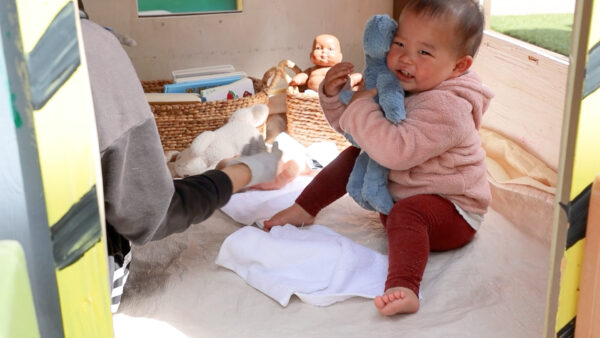
For example, a child may...
- Engage in purposeful back-and-forth play, such as tapping another person’s nose.
- Gesture toward a desired object or food while reaching, making vocal sounds (“Yeh, yeh!”), and looking toward a caregiver.
- Express “No!” repeatedly when presented with choices for which bedtime story to read.
- Look in the direction of a person’s gesturing or pointing, especially when that person shares the child’s culture and language.
- Pick up keys dropped by a caregiver and then give them to the caregiver.
- Learn more complex behaviors through imitation, such as watching an older child put toys together and then trying to do it themself.

For example, a child may...
- Move into and out of pretend play roles, tell a person what they should do in their roles, or extend the sequence, such as by asking in Vietnamese “Uống gì không?” (Wanna drink?) after bringing pretend food to the table as a waiter.
- Name their own feelings or desires, explicitly contrast their feelings or desires with another’s, or describe why they feel the way they do.
- Describe what happens during the bedtime routine or another familiar everyday event.
- Communicate, “Manita (approximation of “little sister” in Spanish) needs milk!” when noticing a baby sibling crying.
- Help a caregiver clean up at the end of the day by putting toys in their usual places.
- Bring a toy to a peer when noticing a peer does not have a toy.
Note: This foundation is closely related to Foundation 2.1 Attention and Foundation 3.2 Collaborative Effort in the ATL domain. Together, these foundations all describe how children learn through shared focus of attention between individuals and a shared object or event.
Social Referencing and Similarity
As infants and toddlers learn about their environment and social behavior through strategies like following eye gaze and imitation, they tend to rely on caregivers of a similar background to them. Thus, an infant may be more likely to imitate a caregiver who speaks their home language (Altınok et al., 2022; Marno et al., 2016) or who is of the same race (Dillmann et al., 2024).
Foundation 2.2Empathy
Indicators
4–11 Months
Children demonstrate awareness of others’ feelings by mirroring or reacting to their emotional expressions.
11–23 Months
Children change their behavior in response to the feelings of others even though their actions may not always make the other person feel better. Children show an increased understanding of the reason for another’s feelings and have emotional responses based on others’ emotional experiences (for example, become distressed by the other’s distress).
23–36 Months
Children show an understanding that other people have feelings that are different from their own. Children show concern for others and sometimes respond to other people’s emotional needs in a way that might make that person feel better.
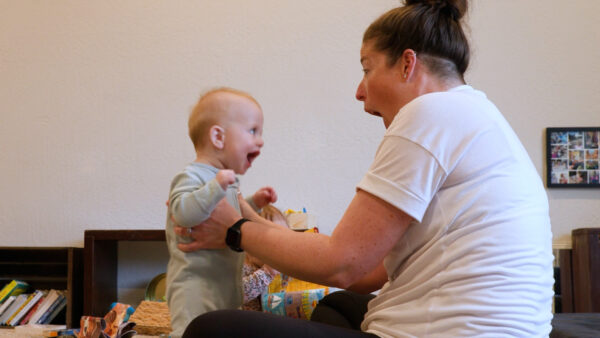
For example, a child may...
- Frown or cry when another child cries.
- Stop playing and turn their head toward a child who is crying.
- Laugh when an older sibling or peer makes a funny face.
- Return the smile of a familiar person.
- Laugh and squeal when another child laughs and squeals.

For example, a child may...
- Notice a playmate crying and pull on a caregiver’s clothes to get the caregiver to come over.
- Become upset when another child throws a tantrum.
- Gently pat a crying peer on their back, just like a caregiver did earlier in the day.
- Try to hug a peer who appears upset or nervous.
- Stop playing and look with concerned attention at a child who is screaming.
- Bring a stuffed animal or comfort item to a child who appears upset.
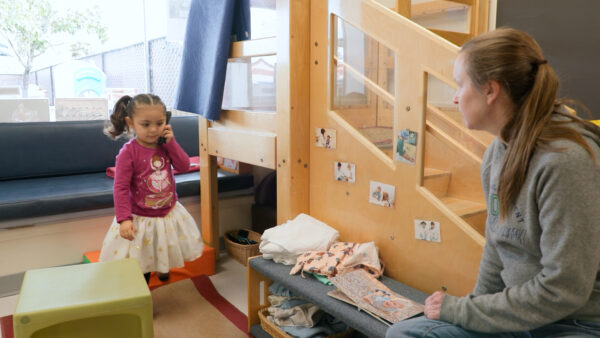
For example, a child may...
- Make a funny face to try and make a crying sibling smile.
- Communicate, “Erin is mad ’cuz Alma didn’t share.”
- Sign in American Sign Language (ASL), “Auntie sad,” when they see their aunt crying in response to a movie.
- Communicate the feelings of a character in a story based on a picture, saying in Spanish, “¡Oso está feliz!” (Bear is happy).
- Comment in a shared home language, “It’s okay” to a child who has fallen down and is crying and get a caregiver to help.
Foundation 2.3Interactions With Caregivers and Other People
Indicators
4–11 Months
Children purposefully engage in reciprocal interactions and follow the gaze of a familiar person (for example, care educator) to an object or person. Children are both interested in and cautious of unfamiliar people.
11–23 Months
Children participate in routines and complex back-and-forth interactions and engage familiar people intentionally to receive help with meeting their needs. Children continue to show interest in unfamiliar people, and gradually interact with them in the presence of a familiar person. Children also check with a familiar person when uncertain about something or someone.
23–36 Months
Children interact with familiar and unfamiliar people to play, solve problems, or communicate about experiences or ideas.
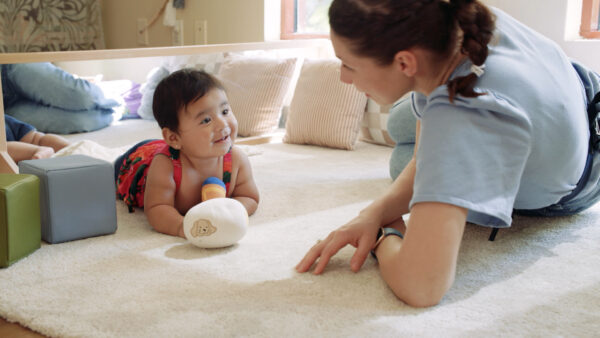
For example, a child may...
- Nestle/snuggle up in the arm of the care educator when a visitor enters the classroom but watch the visitor with interest.
- Engage in games such as pat-a-cake and peekaboo.
- Take a familiar person’s hands and rock forward and backward as a way of asking the person to sing a favorite song.
- Vocalize to get a familiar person’s attention.
- Follow the gaze of a familiar person with interest as they reach for a favorite rattle.

For example, a child may...
- Watch how the caregiver interacts with an unfamiliar person and gradually approach that person to show them a favorite toy.
- Seek reassurance from a familiar person when unsure if something is safe.
- Take a washcloth to a familiar person when the person points to the washcloth and verbally prompts them.
- Allow an unfamiliar person to get close only after the person shows interest in a wooden spoon that is also interesting to the child.
- Watch and then help a familiar person as they prepare a snack.

For example, a child may...
- Ask a classroom visitor their name using words or picture symbols.
- Participate in storytelling with a visitor.
- Point out a rainbow to a person and communicate in Mandarin, “彩虹” (Rainbow).
- Problem-solve how to fill the watering can for the plants with a familiar person.
- Tell a care educator from the classroom next door about an upcoming birthday party.
Foundation 2.4Interactions With Peers
Indicators
4–11 Months
Children show interest in familiar and unfamiliar peers. Children stare at other children, explore other children’s faces and bodies, or respond to siblings and older peers.
11–23 Months
Children engage in simple back-and-forth interactions with peers for short periods of time.
23–36 Months
Children engage in simple cooperative play with peers around a shared goal or a shared activity.

For example, a child may...
- Coo or vocalize as a sibling engages in interaction with them.
- Observe a crying peer with a serious expression.
- Watch other children with interest.
- Touch the eyes or hair of a peer, if infant primarily relies on touch.
- Laugh when an older sibling makes a funny face.
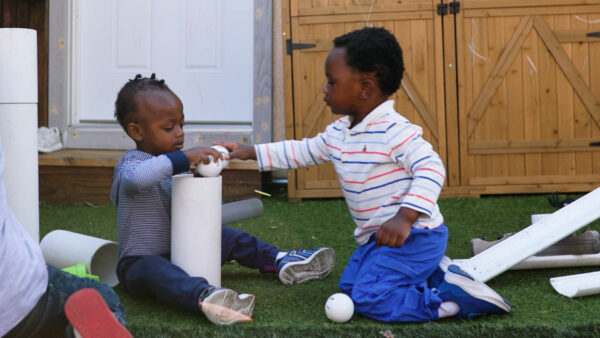
For example, a child may...
- Take turns with a sibling snuggling with a weighted stuffed animal.
- Grab a toy back from another child who took the toy.
- Offer a snack to another child, with encouragement from a caregiver.
- Tickle another child who laughs, get tickled back and laugh, and tickle the other child again.
- Place a basket on their head and then laugh when a peer does the same with their own basket.

For example, a child may...
- Share items with two peers at the play kitchen as part of acting out household tasks.
- Communicate with peers about what they are making while playing together with outdoor materials.
- Act out different roles with peers, sometimes switching in and out of their role.
- Build a tall tower with one or two other children.
- Give a peer a block or piece of railroad track when building something together.
Note: This foundation is closely related to Foundation 3.2 Collaborative Effort in the ATL domain. Both foundations describe how children learn through interactions with others.
Strand 3.0Relationships
The Relationships strand includes infants’ and toddlers’ close relationships with their caregivers and peers, such as attachment relationships with primary caregivers and early friendships with peers.
Age: Birth–4 Months
First Four Months
Young infants attach with caregivers who provide physical closeness and care, especially when that care is consistently responsive in addressing their needs and interests and regulating their distress. Infants learn from the relationships they form in the first few months of life about how to interact with other people. In the early months, infants experience the following:
- often express the most pleasure or show least signs of distress when being held or when they are physically close to their primary caregivers during waking hours
- respond to the behaviors and emotional expressions of others (for example, sticking their tongue out when a familiar person sticks their tongue out or matching the pitch of vocal sounds)
- respond to others’ social bids with engagement cues such as social smiles (for example, smiling or laughing in response to caregiver)

Age: 4–36 Months
Foundations for ages 4–11 months, 11–23 months, and 23–36 months.
Foundation 3.1Relationships With Caregivers
Indicators
4–11 Months
Children initiate interactions and seek proximity with familiar caregivers with whom they have developed an attachment relationship (attachment figures).
11–23 Months
Children explore the environment in the presence of attachment figures. Children prefer people they trust to provide comfort. When distressed, children often seek to be physically close to attachment figures.
23–36 Months
When exploring the environment, children occasionally reconnect with attachment figures (for example, through eye contact, facial expressions, and shared attention through conversations about shared feelings, activities, or plans). When distressed, children may seek to be physically close to these caregivers.

For example, a child may...
- Cry out or follow after a family member when that person leaves the childcare setting and seek comfort from a caregiver by crying and looking for them.
- Continue crying for several minutes after their parent leaves and eventually be soothed when the care educator rocks their baby basket.
- Lift their arms to be picked up by a caregiver.
- Crawl quickly toward a caregiver when alarmed by a loud noise.
- Turn excitedly and raise their arms to greet a family member at pick-up time.

For example, a child may...
- Cry when a family member leaves the childcare setting but calm down when that person comes back for another hug and stands for a few minutes outside the window.
- Run in wide circles around the outdoor play area, circling back each time and hugging the legs of the care educator before running off again.
- Wave at a caregiver from the top of the play structure to make sure they are watching.
- Follow a caregiver physically around the room.
- Play away from a caregiver and then move close to them from time to time to check in.
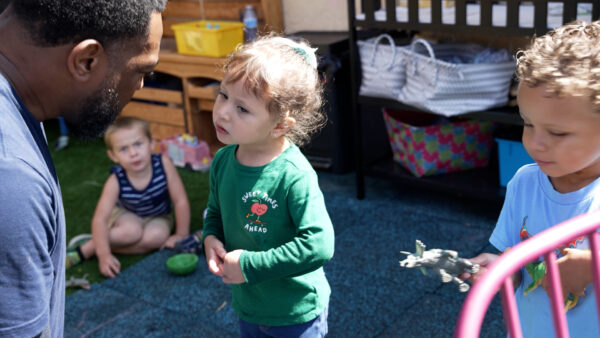
For example, a child may...
- Call out for a family member and briefly look out the window for that person after they leave the childcare setting.
- Communicate to their caregiver in Spanish, “Nos gusta este” (We like this one) while gesturing at an image in the funny story they are reading together.
- Play on the other side of the play yard, away from the care educator, but cry to be picked up after falling down.
- Call “Mama!” from across the room while playing to make sure that their mother is paying attention.
- Bring a caregiver’s favorite book to them and express in Cantonese, “再多一本?” (One more?) to see if the caregiver will read one more book, even though the caregiver had just said to the child in Cantonese, “我地睇完書。依家係時候去瞓覺啦。” (We’re all done reading. Now it’s time for nap).
- Seek the attention of a caregiver and communicate in Spanish, “¡Míra!” (Watch!) before proudly displaying a new skill.
- Look around anxiously when seeing cars pulling up for pick-up and calm down when the care educator points out different colors of the cars with picture cards and communicates, “Your mommy has a white truck. Let’s name the colors of the cars together!”
Multiple Attachment Figures
Infants and toddlers may develop relationships with multiple attachment figures, including parents, extended family, relatives, and care educators (Cassidy & Shaver, 2008; De Schipper et al., 2008). Children benefit when they have access to caregivers who provide sensitive and responsive care, both at home and from other relatives or caregivers outside the home. It is important to note that sensitive, responsive, and consistent relationships with care educators in early care and education may offer children an opportunity to develop alternative or new working models of relationships that they might not have access to at home (Howes & Ritchie, 2002).
Foundation 3.2Relationships With Peers
Indicators
4–11 Months
Children show interest in other children’s actions, feelings, and interests.
11–23 Months
Children prefer to interact with one or two familiar children in a shared space and engage more frequently in the same kind of back-and-forth play when interacting with those children.
23–36 Months
Children prefer to interact with the same small number of children in the group and engage in more complex play with those children than with other peers (for example, extended pretend play with roles, games with movement).

For example, a child may...
- Laugh when a peer bangs an object against a table where they are sitting.
- Attend to a crying peer with a serious expression.
- Watch other children with interest.
- Stretch their foot out to touch a peer.
- Try to get the attention of another child by smiling at them or babbling to them.
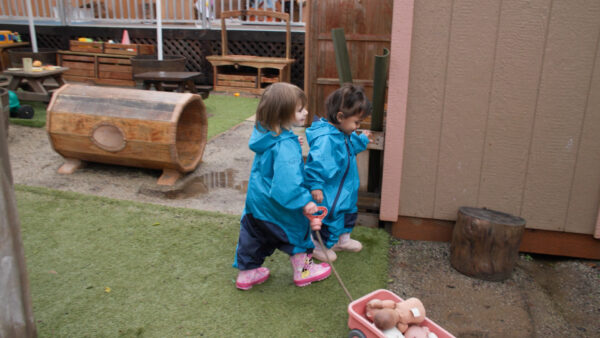
For example, a child may...
- Bang objects on the table while nearby peers one after the other squeal with excitement.
- Choose to play in the same area as other peers.
- Show a toy to a peer.
- Play the same kind of game, such as run-and-chase, with the same peer almost every day.
- Imitate parts of a familiar story that a sibling is reading to them in Tagalog.
- When a peer starts making a pile of small sticks during supervised play, add a stick to the pile and get frustrated when the pile falls down.

For example, a child may...
- Watch and stay close to two friends busy playing with bongo drums and frown when not invited to play.
- Choose to play with a sibling instead of a less familiar child.
- Exhibit sadness when their favorite friend is absent one day.
- Seek one friend for running games and another friend with sensory sensitivity for playing at the sand table.
- Engage in social pretend play with one or two friends (for example, pretend to be a horse while a friend pretends to be the farmer).