
Domain
Cognitive Development
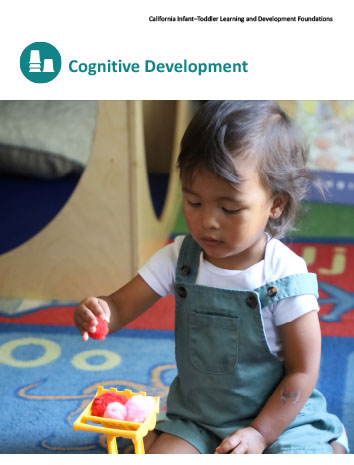
Cognitive development describes how infants and toddlers think, reason, explore, understand, and interact with objects and people in their environment. It includes the development of knowledge and skills that allow children to relate to the world around them. As infants and toddlers explore their environment, their brains process and organize new information, notice patterns, and form memories that support their ongoing learning. The more opportunities infants and toddlers have to interact with objects, test out ideas, or explore new environments, the stronger the connections in the brain and the stronger the learning.
Why is Cognitive Development Important?
Cognitive development is essential for children’s overall learning and development. Symbolic thought, for example, sets the foundation for early literacy. Cognitive skills form the foundation for increasingly complex skills in STEM (Science, Technology, Engineering, and Math) in later years. Children’s understanding of cause and effect is very important for their abilities to understand how objects work, make predictions, and solve problems. Children’s developing abilities to understand quantity, count, and manipulate objects in space is important for their life-long learning in math.
What Skills and Knowledge are Described in the Cognitive Development Domain?
The skills and knowledge described in the Cognitive Development domain are organized into the following four strands:
- Exploration
- Emergent Mathematical Thinking
- Imitation and Symbolic Thinking
- Memory
Foundations for birth–36 months
Open the strands below to explore how the foundations apply to age periods birth–4 months, 4–11 months, 11–23 months, and 23–36 months.
Strand 1.0Exploration
This strand focuses on how infants and toddlers develop an understanding of cause and effect through the exploration of their environment. Related skills and behaviors such as children’s curiosity, initiative, and problem-solving skills are addressed in the Approaches to Learning domain.
Age: Birth–4 Months
First Four Months
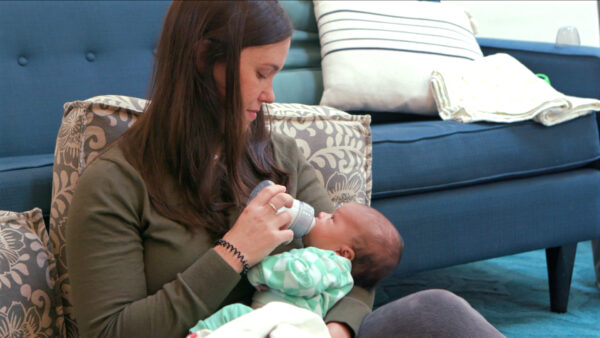
Infants are born curious to discover the world around them. They learn about objects, people, and events by using their senses. Young infants explore their environment and develop an understanding of cause and effect as they experience the following:
- startle at loud sounds by kicking their legs, moving their arms, arching their back, or crying
- pay particular attention to faces or voices of caregivers (for example, they may look at a caregiver’s face during feeding time or smile when they hear a caregiver talking)
- visually track objects or people in their field of vision by focusing their gaze on areas of high contrast (for example, their gaze may follow a caregiver walking from one side of their crib to the other)
- explore objects by holding them in their hands, touching them, looking at them, listening to the sound they make, or bringing them to their mouth
- act on objects within their reach to explore cause and effect (for example, infants might kick their legs or move their arms to cause a baby gym to move, or push objects away from their body to watch how they move)
Age: 4–36 Months
Foundations for ages 4–11 months, 11–23 months, and 23–36 months.
Foundation 1.1Cause and Effect
Indicators
4–11 Months
Children perform simple actions to make things happen. Children may repeat the same action multiple times.
11–23 Months
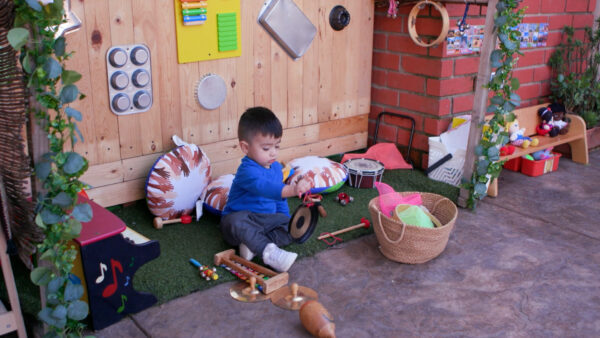
Children purposefully and repeatedly perform simple actions to cause things to happen. Children change the way they perform these actions or interact with objects and people to observe how it changes the outcome.
23–36 Months
Children make simple predictions about what will happen and reflect upon what caused something to happen.

For example, a child may...
- Drop an object from their highchair and watch it fall with fascination, wait for a caregiver to hand the object back to them, then drop the object to the floor again.
- Shake a rattle, hear the sound it makes, and then shake it again.
- Smile in response to a family member gently shaking a rattle and listen to the sound the rattle makes.
- Loudly bang their hands on the table, notice the loud sound, and do it again.
- Squeeze a piece of fruit in their hands and notice how it softens, then grab another piece of fruit and squeeze it again.
- Put an object into a container, turn the container over and watch the object fall out, and then fill the container up again.
For example, a child may...
- Drop a ball down a ramp to see how far it will go, then drop a cube block down the same ramp.
- Splash their hands in water repeatedly and notice how their face gets wet, and then splash their hands even harder, noticing how the water splashes up higher.
- Push the button on a favorite music toy and begin to sway to the music, then push the button again when the music stops.
- Build a tower with objects and kick it over to make it fall, then build it again and knock it down with their hand.
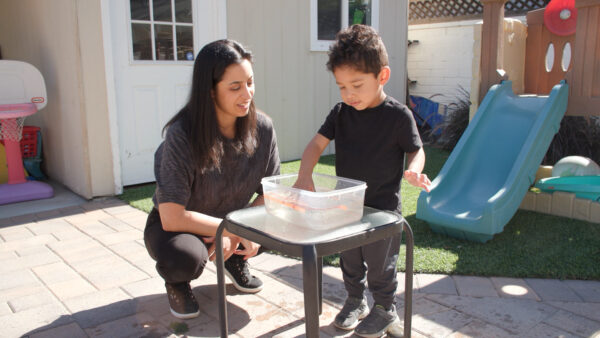
For example, a child may...
- Drop different toys like balls and cars down a ramp, then point to a ball and communicate in Spanish, “Este va más rápido” (This one goes faster).
- Make a prediction about what will happen next in the story when a caregiver asks, “What do you think will happen next?”
- Watch a bird eat some seeds from the ground, then communicate to the caregiver that the bird is hungry.
- Observe a bandage on a peer’s knee and ask in Mandarin, “怎么了” (What happened?).
- Scoop sand into a sifter, notice the sand pour out of the sifter onto the ground, and then move the sifter over a bucket to fill it.
- Communicate in their home language, “She misses her mommy” when a child cries after her mother leaves in the morning.
Children’s Interests and Curiosity Drive Their Exploration
Curiosity and initiative, skills and behaviors in ATL, support children’s cognitive development. Infants and toddlers are naturally curious to explore their environment. They learn about objects and people through exploration. The ways children explore may differ based on individual and cultural differences and experiences. For instance, some children are more curious about people, whereas others are more curious about objects (Lee et al., 2023). Some children may be interested in exploring objects visually (Piccardi et al., 2020), while others may enjoy exploring with their hands. Children’s interests and curiosity drive their exploration.
Strand 2.0Emergent Mathematical Thinking
This strand focuses on infants’ and toddlers’ developing understanding of number and spatial relationships and their ability to classify objects into groups based on similarities and differences.
Age: Birth–4 Months
First Four Months
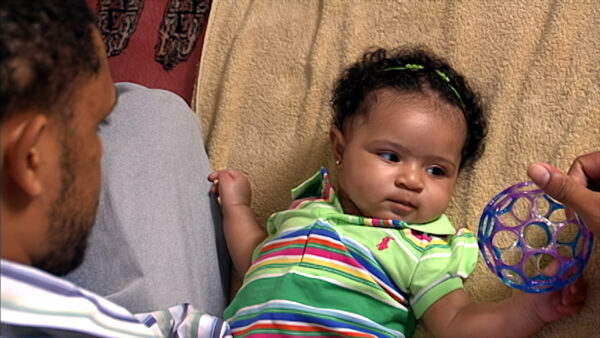
As infants explore their world, they encounter a variety of objects and people. Through interactions with objects, infants notice similarities and differences between them. They notice the size, shape, color, or quantity of objects. They also explore how objects and their own body move in space. These skills are important precursors to infant’s emergent mathematical thinking. Some of the ways infants develop early mathematical knowledge and skills include the following:
- notice when a familiar person enters the room (for example, by smiling at them)
- shift their gaze back and forth between two objects to notice similarities and differences (for example, they may look back and forth between two blocks of different shapes)
- follow the movements of objects in space, such as a mobile
- hold objects and explore them by touching them, putting them in their mouth, looking at them, hearing them make sounds, and moving them (for example, they may put a rattle in their mouth or shake it)
- interact with two objects at the same time, such as holding one object in each hand or putting them into their mouth one at a time
- notice or show interest when the number of objects in their environment changes (for example, they notice when a caregiver adds two new objects to their playmat)
Age: 4–36 Months
Foundations for ages 4–11 months, 11–23 months, and 23–36 months.
Foundation 2.1Number Sense
Indicators
4–11 Months
Children notice quantity in their environment using their senses or physically interacting with objects.
11–23 Months
Children notice quantity when playing and interacting with objects. Children understand and sometimes use language to refer to quantity (for example, “more” and “all”).
23–36 Months
Children use number words to refer to quantity or when answering the question “How many?” Children recite parts of the count list, although they may make mistakes (for example, “one, two, four, five”).
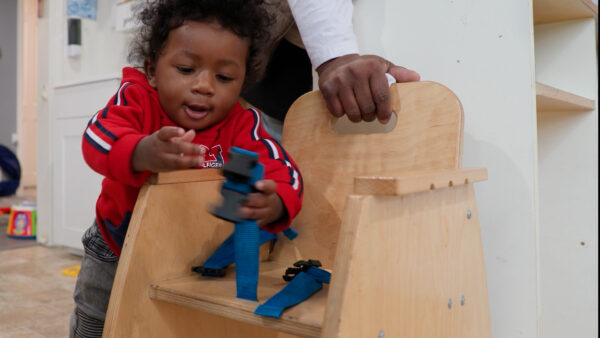
For example, a child may...
- Follow the movement of four animal characters hanging from their baby gym and then reach for one of the animals, following its movement.
- Observe a person who is stacking one ring after the other onto a post.
- Explore one object at a time by holding it, shaking it, or putting it in their mouth.
- Choose the plate with more crackers.
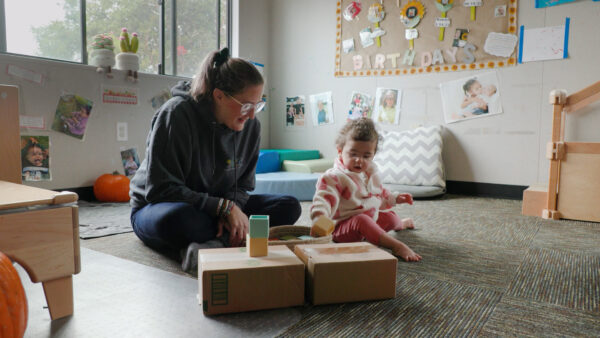
For example, a child may...
- Notice another toy animal on the other side of the rug, while playing with two toy animals. Move over to grab the third toy animal and communicate to a caregiver in Cantonese, “睇吓,多啲。” (look more).
- Hold up two fingers when a family member asks in their home language, “How old are you?”
- Pick up hand-sized rocks on the ground, then hold up each rock and give them to the caregiver to put in a bucket.
- Make a big pile of objects and a little pile of objects.
- Communicate in Tagalog, “Ubos na” (All gone) when they finish eating their lunch.
- Communicate “more” and point to a bowl of fruit.
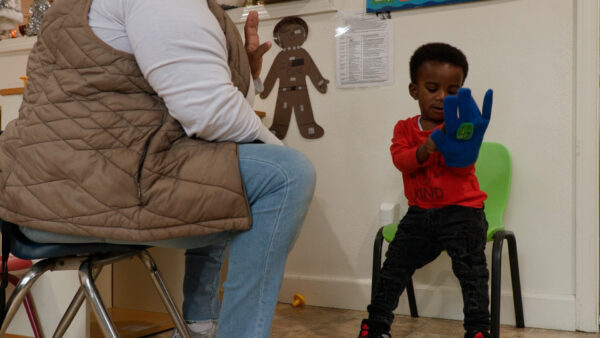
For example, a child may...
- Begin to count a set of three toy animals when a caregiver asks in Cantonese, “你有幾多隻動物?” (How many toy animals do you have?). Point to the same animal twice and communicate in Cantonese, “一、二、四、五。” (One, two, four, five.)
- Join in with a caregiver who is counting from one to ten while reading a book and then repeat some but not all of the number words, “One, two, three, five, five, … ten!”
- Recite the numbers from one to ten, while singing a familiar counting song.
- Communicate in Spanish, “Tienes más” (You have more) when comparing the objects in their basket and their peer’s basket.
- Grab two spoons and give them to a person after they ask, “Can you give me two spoons?”
Foundation 2.2Spatial Thinking
Indicators
4–11 Months
Children explore the movement of their bodies, how people and objects move through space, and the size and shape of objects.
11–23 Months
Children demonstrate understanding of where objects are located in space, and use trial and error to discover how objects, or their bodies, move and fit in space.
23–36 Months
Children predict how objects will fit and move in space without having to try out every possible solution. Children show understanding of words used to describe sizes (for example, big, small, little), locations (for example, in, on, under) or directions (for example, up, down) in space.
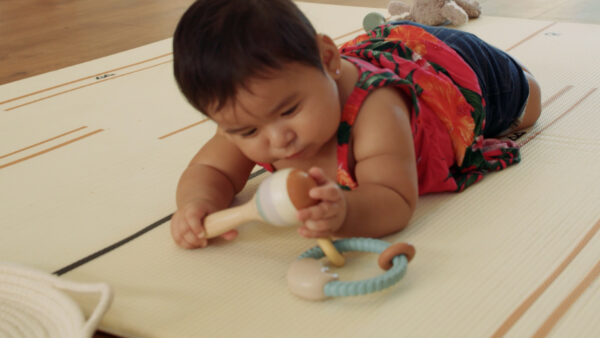
For example, a child may...
- Follow a person with their gaze as the person walks around the room.
- Grab a piece of fruit and put it in their mouth, transfer it to their other hand, then put it in their mouth again.
- Put a stuffed animal into a basket, dump it out, and then put the stuffed animal back in the basket.
- Drop a ball and watch it roll away under a chair.
- Stack one object on top of another and then observe the objects tumble down as they try and add a third object to the tower.
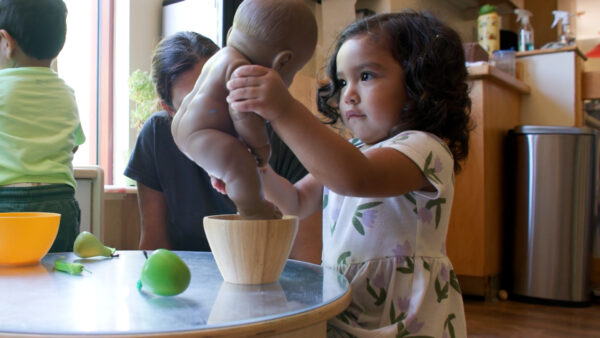
For example, a child may...
- Watch as a person jumps over a hurdle in an obstacle course, and then after the child tries to jump over the hurdle a few times, they crawl under the hurdle instead.
- Notice an object roll under a chair and then move to the chair to grab it.
- Try to move their assistive mobility device (such as an adaptive walker) from the grass to the asphalt when the surfaces are uneven.
- Stack three containers of different sizes inside one another, after trying some combinations that do not work.
- Climb into a low laundry basket and then climb back out.
- Try to fit a shape block into the shape sorter, and when it does not fit, turn the shape until it fits.
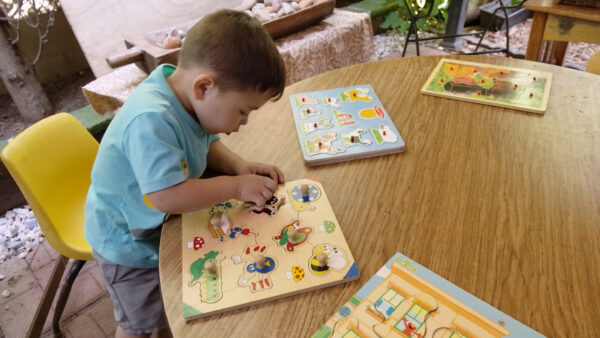
For example, a child may...
- Crawl through a tunnel and jump into a hoop in an obstacle course. When arriving at a hurdle, the child communicates in Mandarin, “太高了” (Too high) and crawls under the hurdle rather than jumping over it.
- Turn a puzzle piece so that it fits in the right place of a puzzle.
- Get the big plates from the cupboard after a caregiver asks in American Sign Language (ASL), “Can you get the big plates for lunch today?”
- Look under the table when a caregiver communicates, “I think your cup fell under the table.”
- Use an alternative or augmentative communication (AAC) device to communicate big or little when playing a game “Is It Big? or Is It Little?” with a peer.
- While pretending to cook food, follow another person’s directions in Vietnamese, “First you put it in the pan, then you stir it, then you put the lid on top.”
Foundation 2.3Classification
Indicators
4–11 Months
Children notice and attend to similarities and differences between objects (for example, based on color, shape, size, or texture) and distinguish between familiar and unfamiliar people, places, or objects.
11–23 Months
Children match objects that are the same or sort objects into two groups based on similarities and differences in one attribute (for example, color, shape, size, or texture).
23–36 Months
Children sort objects into two or more groups based on similarities and differences in one attribute (for example, color, size, shape, or function). Children sometimes label these groups, although these labels may be overgeneralized (for example, labeling all fruits “banana”).

For example, a child may...
- Choose to play with the same stuffed animal they played with yesterday even though there are other stuffed animals nearby.
- Explore how various objects feel by putting them in their mouth.
- Look in the direction of an unfamiliar voice when they hear it as the person enters the room.
- Choose two red cars from a pile of differently colored toy cars.
- Explore a new fruit at lunchtime by touching, squeezing, tasting, and looking at the fruit.
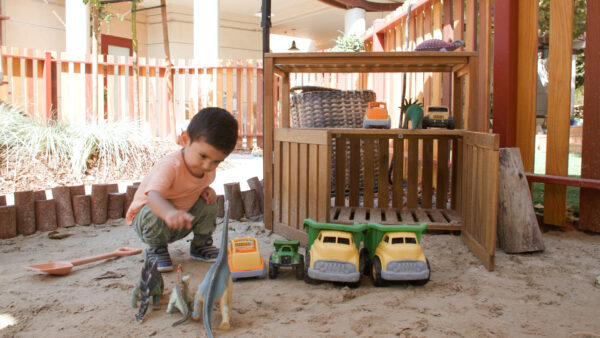
For example, a child may...
- Notice a toy animal in a basket of cars and communicate in Spanish, “Mira” (Look), and then grab the toy animal out of the basket and put it with the other toy animals.
- Eat only the melon pieces in their fruit salad, leaving the rest of the fruit on their plate.
- Look around and point to a toy fire truck, when a caregiver asks in Spanish, “Can you find another fire truck like this one?”
- Put all the small socks into one basket and all the big adult socks into another basket.
- Point to a cowboy hat, a baseball cap, and a winter hat in a book when the caregiver asks, “Where are the hats?”
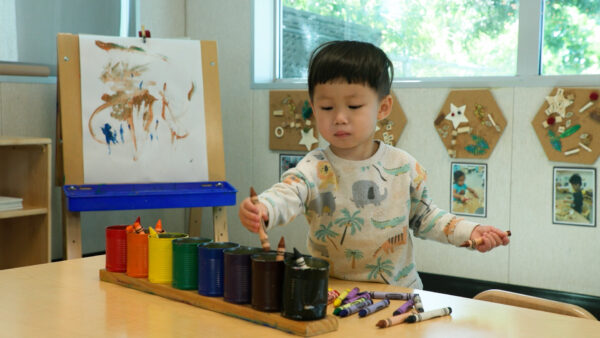
For example, a child may...
- Put all the toy animals in one pile and all the cars in another pile and label the piles in Spanish “animales” and “carros” (animals and cars).
- Put all cups on one shelf and all plates on another shelf while playing in the dramatic play area.
- Name all four-legged animals at the farm “músmus” (cow) in Karuk even though some are sheep and others are horses.
- Place all big leaves in one pile and all small leaves in a second pile.
- Sort blocks into three piles by color regardless of their shape: red, yellow, and blue.
Strand 3.0Imitation and Symbolic Thinking
This strand focuses on how infants and toddlers imitate other people’s actions or sounds, and children’s understanding that certain objects or actions can represent other objects or actions.
Age: Birth–4 Months
First Four Months
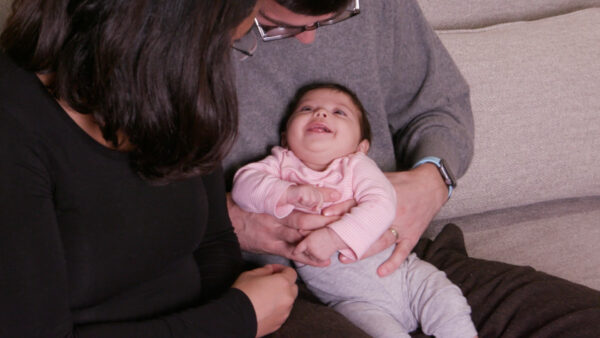
Infants use caregivers as a model for how to behave and how to interact with objects and the environment. Infants notice what caregivers do and imitate them. Imitation is one of the earliest tools for learning cognitively and socially. Imitation is also important for children’s later symbolic thinking. In the first four months, children develop an understanding of objects, people, and actions, as they engage in the following:
- make cooing sounds in response to others, sometimes in a back-and-forth manner, almost like a conversation (for example, they may make the sound “ahh” in response to a caregiver saying, “Good morning!”)
- imitate a caregiver’s facial expressions or simple movements (for example, they may smile or stick out their tongue in response to a caregiver doing the same)
- hold objects and explore them by touching them, putting them in their mouth, looking at them, hearing them make sounds, and moving them (for example, they may put a rattle in their mouth or shake it)
Age: 4–36 Months
Foundations for ages 4–11 months, 11–23 months, and 23–36 months.
Foundation 3.1Imitation
Indicators
4–11 Months
Children imitate simple actions, sounds, or facial expressions of others during interactions.
11–23 Months
Children imitate simple actions, sounds, or gestures that they have observed others doing in the moment or at an earlier time.
23–36 Months
Children imitate gestures, language, and actions with multiple steps that they have observed others doing at an earlier time and/or in a different context.
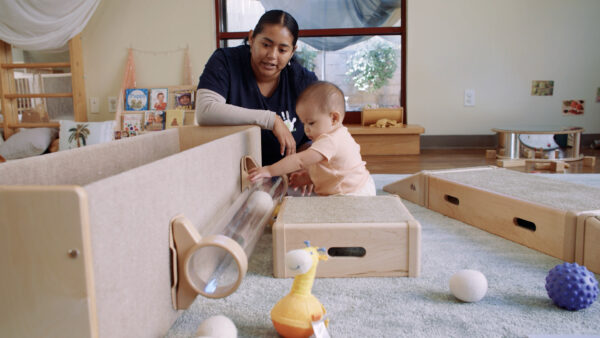
For example, a child may...
- Babble “babababa” when a family member says “bye-bye” to them.
- Smile in response to a familiar person smiling.
- Imitate the caregiver’s movements when playing peekaboo.
- Clap their hands together in response to hearing a caregiver clap their hands.
- Push a button on a music toy after watching another person do it first.
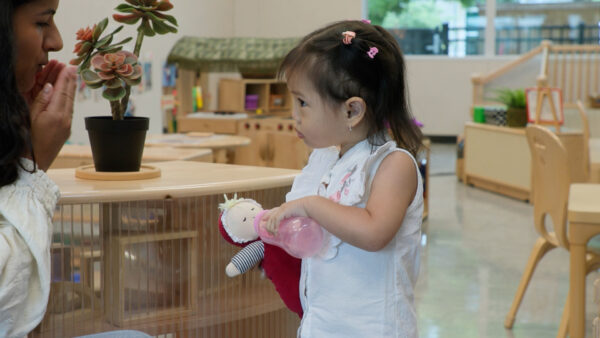
For example, a child may...
- Take a purse from the dramatic play area and say “bye-bye” while walking toward the door.
- Hold a family member’s cell phone up to their ear after watching the family member talk on the phone a few hours earlier.
- Rock the baby doll to sleep and pat its back.
- Flip through the pages of a book and then close it, communicating “all done” in their home language.
- Imitate using a toy hammer after watching construction workers outside using tools.
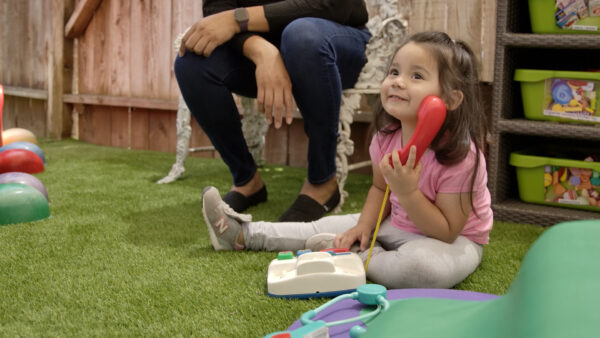
For example, a child may...
- Communicate, “See you later alligator,” when saying goodbye to a person, after having heard a caregiver say this same phrase to them.
- Pick up a toy phone, pretend to dial a number, hold it up to their ear and say a heartfelt greeting in Yurok “Aiy-ye-kwee” (Hello, I missed you!). Then engage in a pretend conversation on the phone.
- Play a dance game that involves imitating a person who jumps, twirls, and claps.
- Reenact parts of a birthday celebration by pretending to blow out candles on a cake.
- Pretend to get their doll ready for bed by brushing their teeth, changing their clothes, and communicate “goodnight” in their home language.
Foundation 3.2Symbolic Thinking
Indicators
4–11 Months
Children become familiar with objects and actions through active exploration. Children also build knowledge of people, actions, objects, and ideas through observation.
11–23 Months
Children use one object to represent another object. Children engage in one or two simple actions of pretend play.
23–36 Months
Children use objects to represent other objects during pretend play. Sometimes children pretend by imagining an object without needing the concrete object present.
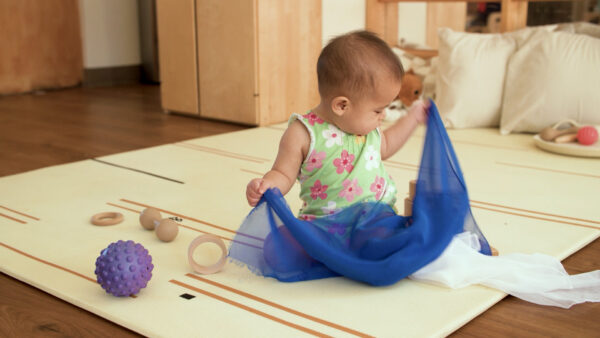
For example, a child may...
- Hold a toy bus and explore how the wheels move.
- Explore objects by holding them and putting them in their mouth.
- Cause a rattle to make noise by shaking and banging it on the ground.
- Roll an object back and forth on the floor.
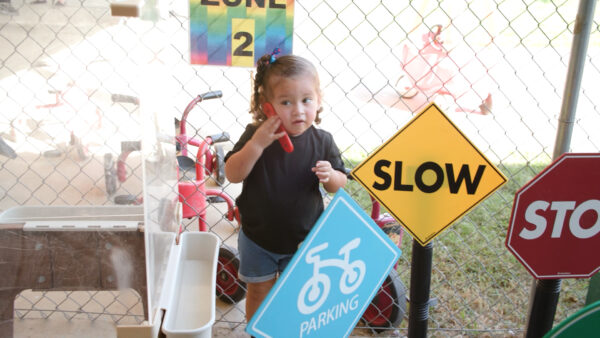
For example, a child may...
- Move a toy bus on the carpet and make the sound “vroom vroom.”
- Pretend to suck from a baby bottle then say in Vietnamese, “uống hết rồi” (Drank it all).
- Put leaves in a pot and start stirring with a wooden spoon, pretending to make soup.
- Make marks on paper and sign in American Sign Language (ASL), “dada.”
- Put a doll in a bed and place a blanket over the doll, then communicate, “night night” in the home language.
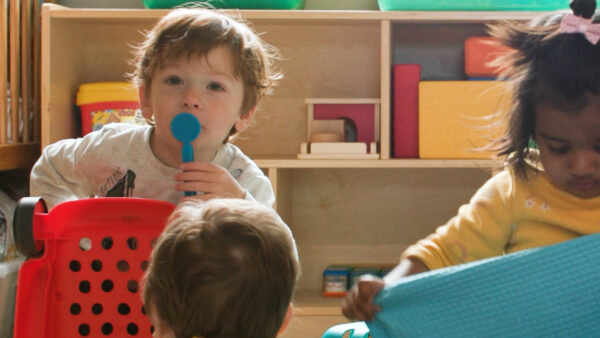
For example, a child may...
- Sit down in a chair and pretend to be a bus driver, while playing in the dramatic play area.
- Draw circular shapes on a piece of paper and communicate that they drew a snowman.
- Build a structure with objects and use toy dinosaurs to knock the structure down, making different dinosaur sounds as the dinosaurs break the structure.
- Point to picture in a book and communicate in Spanish, “¡Se escondió!” (He hid!).
- Plan with another person to pretend to be dogs and then start crawling on all fours, sticking out their tongue, and making barking noises.
Strand 4.0Memory
This strand focuses on infants’ and toddlers’ abilities to recognize familiar people and objects, remember information over a longer period of time, and remember how to perform familiar actions or routines.
Age: Birth–4 Months
First Four Months
Infants develop memories of their caregivers very early on. Right from birth they notice regularities and patterns in their daily routines—for example, patterns in feeding and sleeping schedules. Infants remember these patterns, which allows them to anticipate routines and actions in the future. In the first four months, infants develop memories of caregivers and routines as they engage in the following:
- show recognition of familiar caregivers (for example, they may smile in response to seeing or hearing a familiar caregiver entering the room)
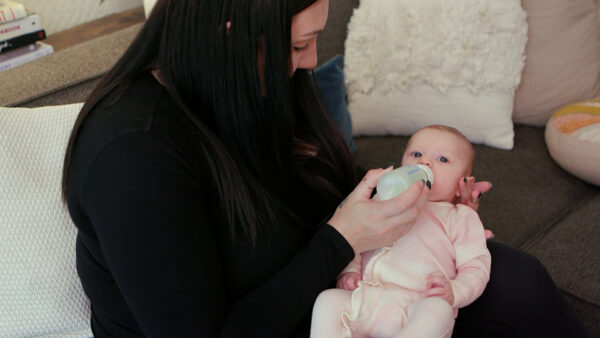
- anticipate simple routines by taking action (for example, they may open their mouth at the approach of bottle or breast)
Age: 4–36 Months
Foundations for ages 4–11 months, 11–23 months, and 23–36 months.
Foundation 4.1Memory
Indicators
4–11 Months
Children recognize familiar people, objects, and routines in the environment. Children show awareness that familiar people still exist even when they are no longer physically present.
11–23 Months
Children remember the typical actions of people, location of objects, and steps of routines. Children use this information as they engage with people or objects or participate in routines doing one or two steps.
23–36 Months
Children anticipate the series of steps in familiar routines or activities, remember characteristics of the environment or people in it, and sometimes communicate about recent past events or act them out.
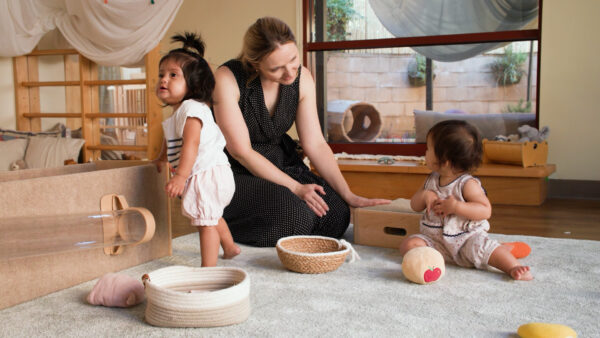
For example, a child may...
- Hold up their arms to be picked up after a caregiver communicates in Spanish, “Are you ready to go outside for our walk?”
- Continue to play peekaboo after a familiar person has stopped playing.
- Kick to make toys hanging from the baby gym move.
- Smile and kick their legs when they see or hear a familiar person walk into the room.
- Crawl toward the door after a family member leaves the room.
- Turn their head toward the front door when hearing the doorbell ring.
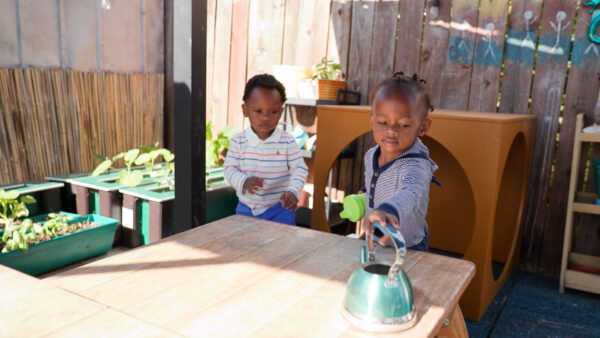
For example, a child may...
- Move toward the shoe bin after a caregiver says in Spanish, “We’re going outside. Where are your shoes?”
- Play a hide-and-seek game with a person, and after watching the person hide a ball inside one of three containers, reach for the correct container to find the ball and communicate in their home language, “Ball!”
- Observe a photo of their grandma and say in Cantonese, “婆婆” (Nana).
- Sit down at the table when they notice a caregiver is preparing lunch.
- Walk to their cubby at naptime to get their blanket from inside the bag.
- Remember how to play with a music toy by pushing the piano keys, after playing with it for the first time the day before.
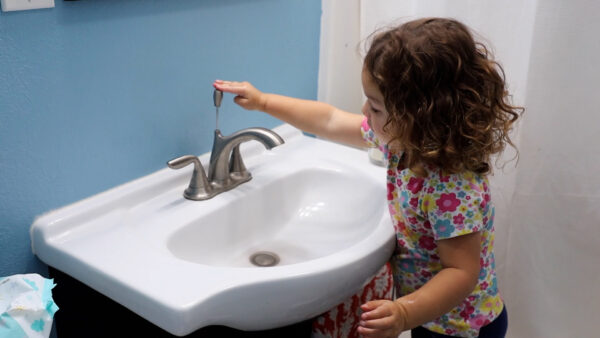
For example, a child may...
- Take off their shoes and hang up their coat in the cubby after playing outdoors, then walk over to the sink to wash their hands.
- Act out a trip to the grocery store while playing in the dramatic play area; get a cart, put food in it, and pay for the food at the cash register.
- Go sit in their basket or lay down on their cot in anticipation of naptime.
- Ask to play with the big foam blocks that are in a storage cabinet by signing “big blocks” to a caregiver in American Sign Language (ASL).
- Tell their family member in the home language, “We jumped in puddles outside” when getting picked up from their care program.
- Sing some of the lyrics to their favorite song or chant.
Note: This foundation is closely related to Foundation 2.3 Working Memory in the ATL domain. The foundation in the Cognitive Development domain describes children’s ability to store and remember past events or experiences. The foundation in the ATL domain describes children’s ability to hold information in mind at a given moment while engaged in everyday interactions and activities. Both foundations are important parts of memory and learning.