
Infant–Toddler Learning and Development Foundations
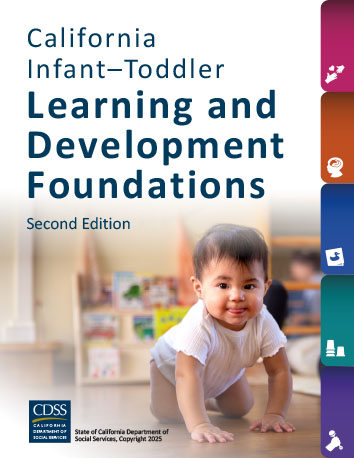
The second edition of the California Infant–Toddler Learning and Development Foundations (ITLDF) describes the development of infants and toddlers during the birth to 3 age period. The ITLDF are designed to align with the California Preschool/Transitional Kindergarten Learning Foundations (PTKLF) in five major domains:
- Social and Emotional Development
- Approaches to Learning
- Language Development
- Cognitive Development
- Perceptual and Motor Development
The Context for Early Learning and Development
Social and Environmental Factors
Young children’s development is influenced by social and environmental factors, including their lived experiences in the context of their families and communities. Children’s experiences in the world are often shaped by interconnected social determinants (for example, economic stability, educational access and quality, health care access and quality, health care access and quality, neighborhood, and social and community context). Social determinants can create high-quality learning opportunities and experiences or lead to inequitable ones that are under resourced or do not accommodate children’s unique strengths and needs.
Family and Community History
The experiences of children and their families in early learning and care settings are also impacted by the historical treatment of their communities. Young children need to see their daily experiences and those of others reflected in their early learning and care settings. It is essential that early development is understood within this perspective. Embracing the strengths of children and families while providing warm, caring, and responsive interactions is essential for the well-being and healthy development of children. Supportive, loving environments where children feel appreciated for who they are and feel emotionally and physically safe and secure help them cope with stress and build resilience.
The Essential Role of Family and Culture
Relationships with caregivers are crucially important in infants’ and toddlers’ development, in both the home and early learning and care settings. The social and environmental contexts where those relationships unfold also have a powerful impact. The ITLDF highlight diverse ways in which infants and toddlers make meaning of their experiences in the context of their families’ cultural beliefs, values, and practices as they learn and develop. The ITLDF also explore how learning experiences with care educators can build on children’s prior knowledge and experiences. The ITLDF inform how care educators can responsively engage with the children, families, and communities they serve.
Individual Differences
A one-size-fits-all approach to supporting early learning and development will not meet the needs of all children. Within a responsive relationship, care educators need to adapt to each unique infant or toddler. A general developmental approach to early learning and care must have built-in flexibility to support and engage each child’s individual strengths, interests, and needs.
In certain situations, some children may have diverse abilities that could benefit from personalized supports as they develop and learn. In supporting the individual strengths and needs of each child, care educators often benefit from working with other professionals such as coaches, consultants, or specialists who may be supporting a child and family.
Early Experiences with Language
Young children from birth to 3 years old develop and learn foundational language knowledge and skills in the languages and language varieties of their homes, communities, and early learning and care settings. The spoken and signed languages and language varieties children experience support their development in other domains, as language is foundational for all learning. In the early learning and care setting, care educators play an essential role in early language development as they communicate and interact with infants and toddlers. Sustained experience with any language, either spoken or signed, is central to children’s language development. Whether a child experiences language interactions in a spoken language like Spanish or Mandarin or a signed language like American Sign Language, these interactions establish a strong foundation. In addition, care educators foster the use of the languages and language varieties children are learning at home.
Guiding Principles
Several guiding principles influenced the creation of the ITLDF. These principles stem both from developmental theory and research and from best practice in the infant–toddler care field.
- Infants and toddlers develop best in the context of supportive, affirming, and nurturing relationships and environments.
- Families, their cultures, and home languages are fundamental to early learning and development.
- Family and community partnerships create meaningful connections and support children’s and families’ sense of belonging.
- Infancy is a unique stage of life that is important in its own right.
- Responsiveness to children’s self-initiated exploration fosters learning and development.
- Early learning and development are integrated.
- Children’s home languages are an asset and establish a strong foundation for learning and development in all domains.
- Children demonstrate varying strengths and needs in their learning and development across domains.
- Infants and toddlers have different ways of knowing and may express their knowledge and skills across domains through various means.
- Play offers engaging, joyful opportunities for learning and development in every domain.
- Intentional planning enhances children’s development through learning opportunities designed to be responsive to individual children’s strengths, interests, experiences, and needs.
Organization of the Foundations
- Domains: The domains show the five areas of early learning and development.
- Strands: The strands identify emerging skills and behaviors that are important for that domain.
- Foundations: The foundation statements describe knowledge, skills, and behaviors that many children will likely demonstrate during the age period.
- Indicator: The indicators describe the competencies—the knowledge, skills, and behaviors—that children develop and learn during a particular age period.
- Examples: The examples for each indicator show different ways children may demonstrate their knowledge and skills.
Explore the Domains
The updated Infant–Toddler Learning and Development Foundations presents 35 foundations across five domains that describe the competencies that infants and toddlers may develop in the first three years of life.
Click on the graphic to read the foundations within each domain.